Best Construction Management Software in UAE & KSA: 2026 Buyer's Guide

Choosing construction management software in UAE or Saudi Arabia is no longer a question of “should we digitise?” It’s a question of which platform your site teams will actually use, where your project data lives, and who supports you when something breaks at 7 a.m. on a Riyadh site. This guide walks you through what the software does, six criteria to compare, how the two leading platforms differ, and a simple 30-day plan to test before you sign. We also map the three software phases of a project (drawing, estimation and site management) so you can see where each tool fits.
What construction management software does for GCC contractors
Construction management software in UAE and KSA replaces the spreadsheets, WhatsApp groups and email chains that most GCC projects still run on. Instead of chasing the latest drawing revision or a photo of a snag, everyone works from one shared, up-to-date record.
For a contractor or developer in the Gulf, the best construction management software in UAE and KSA typically covers:
- Document and drawing control: one current set of drawings, with revision history, accessible on site and in the office.
- RFIs, submittals and approvals: tracked workflows with owners and due dates, so nothing sits in an inbox.
- Site quality and snagging: defects pinned to a plan, with photos, assignees and close-out evidence.
- Daily reports and site diaries: manpower, equipment, weather and progress logged from a phone.
- Health and safety: inspections, observations and incident records in a consistent format.
- Reporting: dashboards that show the client and your management what’s open, late or at risk.
The value is simple: fewer disputes, faster handover, and a clear audit trail when a consultant or client asks, “Who approved this, and when?”
The three software phases of a GCC construction project
Construction software isn’t one tool. Most Gulf contractors use three types, one for each phase of a project: drawing software to design and draft, estimation software to price the work, and site management software to deliver it. When you compare construction management software in UAE and KSA, it helps to see where each type fits, because the best results come when data moves cleanly from one phase to the next.
| Phase | Main job | Who uses it | GFT solutions |
|---|---|---|---|
| 1. Drawing | Design, drafting and drawing revisions | Architects, designers, MEP and structural engineers | ZWCAD |
| 2. Estimation | Quantity takeoff, BOQs and tender pricing | Quantity surveyors, estimators, BIM teams | PlanSwift, Sparkel |
| 3. Site management | Delivery, quality, documentation and handover | Project managers, site engineers, QA/QC teams | Procore, PlanRadar, OpenSpace |
Phase 1: Drawing software (design and drafting)
Every project starts as a drawing. Design teams produce the architectural, structural and MEP drawings that every later phase depends on, and they revise them many times before and during construction. For most GCC firms, the main challenges are licensing cost and staying compatible with years of existing DWG files.
What to look for in drawing software:
- Native DWG compatibility: opens and saves existing drawings, templates and blocks without conversion
- A familiar interface: commands your engineers already know, so retraining is minimal
- Performance: handles large, complex drawings without slowing down
- Licensing model: perpetual licences avoid paying rent on every seat year after year
ZWCAD is a professional CAD solution built around familiar drafting workflows, native DWG compatibility, 2D and 3D tools, and a perpetual licensing model. It’s a practical alternative for teams that want to keep their CAD workflow while cutting long-term software costs. Read more in our guide to choosing a traditional CAD alternative.
Phase 2: Estimation software (takeoff and BOQ)
Once drawings are issued, estimators measure quantities and turn them into a priced BOQ. In the GCC, tender windows are short and projects are large, so a QS team that loses days to manual measurement has less time to check rates and protect margin. Revisions make it harder still: a new drawing issue can restart the whole takeoff.
What to look for in estimation software:
- Fast, visual takeoff: areas, lengths, counts and volumes measured directly on PDF plans
- AI assistance: automatic scaling, counting and detection to speed up the first pass
- PDF and BIM support: most tenders still arrive as PDFs, while larger projects add models
- Revision handling: a clear record of what changed between drawing issues
PlanSwift is known for easy point-and-click takeoff on digital plans. Its Takeoff BOOST suite, released in April 2026, adds four AI tools (Auto Takeoff, Auto Count, Auto Scale and Auto Bookmark). They give estimators a first pass to review instead of hours of setup. Sparkel is a browser-based takeoff platform that reads both PDF drawings and BIM models, including IFC files, in one workspace. Its AI detectors find rooms, areas and repeating symbols and turn them into live quantity rows in your own BOQ format. See how they work in our PlanSwift tutorial from drawing to BOQ and our Sparkel AI guide.
Phase 3: Site management software (delivery and handover)
Once the contract is awarded, the focus moves to site. This is where construction management software in UAE and KSA does its main job: controlling drawings on site, tracking RFIs, managing quality and snags, recording daily progress and building the handover record. It’s also where the six criteria below matter most, because adoption depends on hundreds of field users, not a small office team.
What to look for in site management software:
- One live record: current drawings, RFIs and approvals shared between site and office
- Mobile-first field tools: snags, inspections and daily reports captured from a phone
- Visual progress records: proof of what was built, and when, for disputes and handover
- Room to scale: from one pilot site to your whole portfolio
Procore and PlanRadar cover project control and field quality, as compared below. OpenSpace adds visual documentation. A team member walks the site with a 360° camera clipped to a hard hat, and the software stitches the footage into a time-stamped walkthrough of every space, on every visit. Anyone can then step back to last month and see exactly what was built. Learn more in our OpenSpace 360° capture guide.
How the three phases connect
The biggest gains come when data flows between phases instead of being retyped:
- Drawing to estimation: each drawing revision updates the takeoff, so the BOQ always matches the latest design.
- Estimation to site: the awarded BOQ and budget become the baseline that site teams track progress and changes against.
- Site back to design: RFIs, snags and as-built records feed back to the design team and form the handover package.
GFT supplies, implements and supports software for all three phases, from CAD to construction management software in UAE and KSA. You can start with the phase that’s slowing your projects down most and add the rest when you’re ready.
6 criteria to compare before you buy

Feature lists look similar on every vendor website. When you compare construction management software in UAE and KSA, these six criteria are where platforms really differ for Gulf contractors.
Local support and Arabic/English training
Your teams are multilingual: engineers may work in English, while foremen and subcontractors are often more comfortable in Arabic. Check whether the mobile app offers an Arabic interface, whether training can be delivered in both languages, and whether support is available in your time zone. A strong partner can run on-site training at your project office, not just a webinar from another continent.
Data residency and security
Data rules in the Gulf are tightening. Saudi Arabia’s Personal Data Protection Law (PDPL) has been fully enforceable since 14 September 2024, with specific rules on transferring personal data outside the Kingdom, as summarised in DLA Piper’s guide to Saudi data protection law. The UAE has its own federal data protection framework too. Before you choose construction management software in UAE or KSA, ask each vendor where data is hosted, which security certifications they hold (for example ISO 27001), and how they handle government or giga-project clients with stricter requirements.
Integrations (ERP, BIM, document control)
The software should connect to the systems you already run, not create another island. Ask about:
- ERP and accounting: can budgets, commitments and change orders sync with your ERP?
- BIM: can field teams view models and link issues to model elements? Our BIM execution team can help connect the two.
- Document control: can it work with, or replace, your current EDMS?
- Open API: is there an API so your IT team can build custom connections later?
Field adoption and mobile use
The best platform is the one your site team opens every day. Test the mobile app on a real site: Does it work offline in basements and tower cores? Can a foreman log a snag with a photo in under a minute? Are subcontractors charged per seat, or can they join for free? Low adoption is the most common reason construction management software in UAE projects fails to deliver, so weigh this criterion heavily.
Licensing model and total cost
Pricing models for construction management software in UAE and KSA vary widely. Some platforms charge per user, others charge based on your annual construction volume with unlimited users. Calculate total cost over three years, including:
- Licences and any annual price increases at renewal
- Implementation and data migration
- Training for new staff and new projects
- Add-on modules you’ll need in year two
A per-user model is often cheaper for a small, site-focused team; a volume-based model can work out better when hundreds of people across many projects need access.
Implementation time
Ask how long it takes to go from contract to the first live project. Some tools can be configured and rolled out to a site team within days; full enterprise platforms usually roll out in phases over several weeks, starting with one or two pilot projects. Neither is wrong, but your timeline should match the urgency of your projects and the size of your IT team.
The main platforms compared
Many tools are on the market, but two platforms come up most often when contractors shortlist construction management software in UAE and KSA: Procore and PlanRadar. They solve different problems, so the right choice depends on your company size and priorities.
| Criteria | Procore | PlanRadar |
|---|---|---|
| Best for | Large, multi-project contractors and developers | Site-focused teams, quality, snagging and handover |
| Scope | Full project management, quality & safety, financials | Site documentation, defects, inspections, reporting |
| Licensing | Annual fee based on construction volume, unlimited users | Per user per month, unlimited free subcontractors and watchers |
| Arabic interface | Confirm with GFT for your modules | Yes, Arabic is among 25 supported app languages |
| BIM | Yes, model viewing and coordination tools | BIM model viewing on Pro and Enterprise plans |
| Integrations | Large app marketplace, ERP connectors, API | PlanRadar Connect and Open API |
| Rollout speed | Phased, typically weeks | Fast, often days for a site team |
| Regional presence | Office in Dubai Internet City | Offices serving UAE and KSA |
Procore: for large, multi-project contractors
Procore is a full construction management platform that connects project management, quality and safety, and project financials in one system. Its biggest advantage for large Gulf contractors is the licensing model: Procore charges an annual fee based on your annual construction volume, with unlimited users included. That means you can bring in consultants, clients and every subcontractor without counting seats.
Procore is a strong fit if you:
- Run several large projects at once and want one standard way of working across them
- Need budgets, commitments and change orders tied to project records
- Want to connect the platform to your ERP and other business systems
- Have the internal sponsorship to roll out a company-wide system in phases
Procore opened its first MENA office in Dubai Internet City in 2022 and focuses on the UAE and Saudi markets. For a deeper look, read our guide on why Procore leads construction management in Dubai.
PlanRadar: for site-focused teams and fast rollout
PlanRadar is built around the site: defects, snags, inspections, daily reports and handover documentation, all pinned to your drawings. It’s quick to learn, which makes it popular with site engineers and quality teams who need results this month, not next quarter. The app supports Arabic among 25 languages, and PlanRadar holds ISO 27001 certification and follows GDPR.
PlanRadar is a strong fit if you:
- Need to digitise snagging, quality inspections or handover quickly
- Work with many subcontractors who should report issues without paid licences
- Want a per-user model that starts small and scales with your team
- Manage fit-out, residential or facility management projects with heavy defect tracking
Large contractors in the region already use it; Shapoorji Pallonji, for example, rolled out PlanRadar on its Saudi operations to replace spreadsheets and email trails for issue tracking.
Can you use both? Yes. Some contractors run Procore as the company-wide system and PlanRadar on specific sites where fast, simple field capture matters most. GFT can help you decide whether one platform or a combination of construction management software in UAE fits your portfolio.
How to run a 30-day evaluation
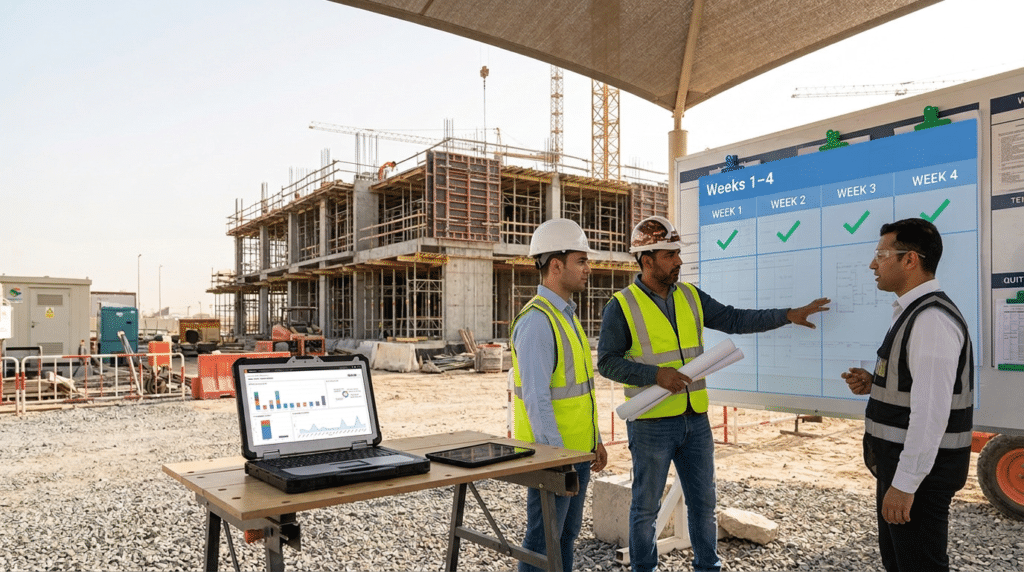
Don’t choose construction management software in UAE or KSA based on a demo alone. A structured 30-day trial on a live project shows you how a platform performs with your real people and data.
Week 1: Define success
- Pick one live project for the trial
- Choose two or three workflows to test, such as snagging, RFIs and daily reports
- Write down measurable goals, such as "close snags 30% faster" or "zero lost RFIs"
Week 2: Set up and train
- Upload current drawings
- Set up users and permissions
- Run short training sessions in Arabic and English for office and site teams
Week 3: Use it for real
- Run the selected workflows only in the new platform
- Ask the site team to log issues daily
- Track how many people use the app each day
Week 4: Measure and decide
- Compare results against your goals
- Collect feedback from site engineers, foremen and subcontractors
- Get a full three-year cost quote
- Decide: scale up, adjust, or try the alternative
Why buy through a local partner like GFT
Buying construction management software in UAE or KSA through a local partner gives you more than a licence. GFT is an authorised partner for Procore and PlanRadar in the region, and our team works with Gulf contractors every day.
When you buy through GFT, you get:
- Honest platform advice: we represent both Procore and PlanRadar, so we recommend the one that fits your projects.
- Arabic and English training: delivered on site or online, for office and field teams.
- Local implementation: setup, data migration and workflow configuration aligned with how GCC projects run.
- Ongoing support in your time zone: a regional team you can call, not a ticket queue overseas.
- One partner for every phase: drawing (ZWCAD), estimation (PlanSwift, Sparkel) and site management (Procore, PlanRadar, OpenSpace), plus BIM and reality capture services.
Ready to Compare Platforms on Your Own Project?
The right construction management software in UAE and KSA is the one your whole team will actually use. Book a free consultation with GFT and we’ll help you set up a 30-day evaluation of Procore, PlanRadar or both.
Frequently Asked Questions
What is the best construction management software in UAE?
There’s no single best tool for every company. Procore suits large, multi-project contractors that need a company-wide platform with financials and unlimited users. PlanRadar suits site-focused teams that need fast rollout for snagging, inspections and handover. The best choice depends on your project size, team and budget.
Is construction management software compliant with Saudi data protection law?
Compliance depends on how and where the vendor processes your data and how you configure the platform. Since Saudi Arabia’s PDPL became fully enforceable in September 2024, ask each vendor about data hosting locations, cross-border transfer safeguards and security certifications before you sign.
How much does construction management software cost in the UAE and KSA?
It depends on the licensing model. PlanRadar charges per user per month, with free access for subcontractors and watchers. Procore charges an annual fee based on your construction volume, with unlimited users. Contact GFT for a quote in local currency based on your projects.
Does PlanRadar support Arabic?
Yes. The PlanRadar apps support 25 languages, including Arabic, so site teams can work in the language they’re most comfortable with.
How long does it take to implement construction management software?
A site-focused tool like PlanRadar can often be running on a project within days. A full platform like Procore is usually rolled out in phases over several weeks, starting with pilot projects. GFT plans the rollout around your project schedule.
Do I need separate software for drawing, estimation and site management?
Usually, yes. Each phase has different users and tasks: designers need CAD, estimators need takeoff and BOQ tools, and site teams need construction management software. The key is choosing tools that share data cleanly. GFT supplies all three phases, so the drawings, quantities and site records stay connected.
Related Topics You Might Want to Check